 Image: tomshardware.com
In a presentation that blended ambitious futurism with hardcore semiconductor engineering, Elon Musk officially launched the Terafab project on March 22, 2026, at the historic Seaholm Power Plant in Austin, Texas. Described by Musk as “the most epic chip building exercise in human history by far,” this joint initiative between Tesla, xAI, and SpaceX represents a bold attempt to solve the looming AI compute bottleneck by bringing advanced semiconductor production in-house at unprecedented scale.
As Tesla pushes toward millions of autonomous vehicles and humanoid robots while xAI and SpaceX eye massive orbital AI infrastructure, relying solely on external foundries like TSMC and Samsung is no longer viable. Terafab aims to change that by creating a vertically integrated “advanced technology fab” capable of producing logic chips, memory, and advanced packaging under one roof.
The Terafab Announcement: What We Learned
The event, which took place just days after Musk teased the “Terafab Project launches in 7 days” on X, drew together the combined forces of his companies to address a critical gap in scaling compute. Musk emphasized that current global semiconductor production falls far short of the terawatt-scale needs driven by Tesla's Full Self-Driving (FSD), Optimus humanoid robots, and SpaceX's future orbital data centers.
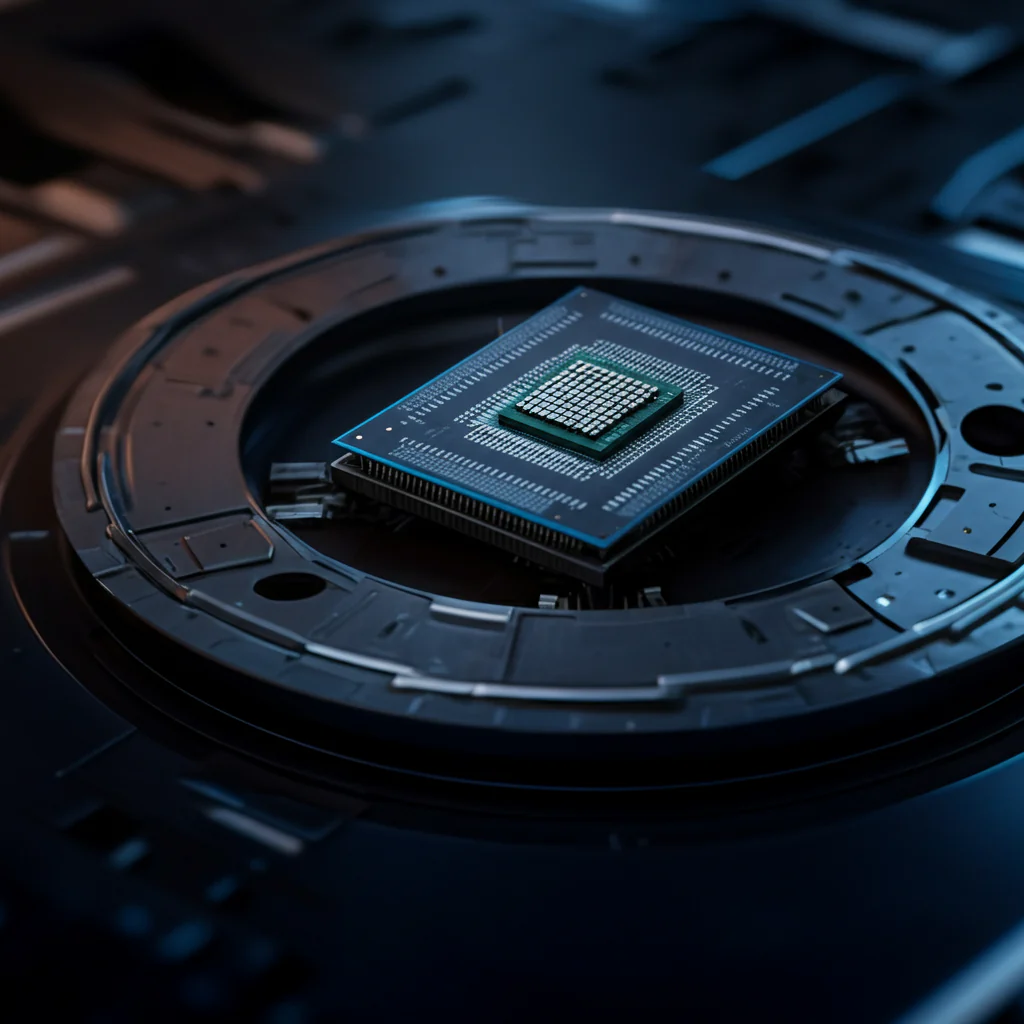 Image: tesevo.com
Key details revealed include:
- A projected $20-25 billion investment for the facility in Austin, located near Giga Texas.
- Target process node of 2 nanometers, focusing on cutting-edge AI inference and training chips.
- Ambitions to achieve 100-200 billion custom AI and memory chips annually, with up to 1 million wafer starts per month at full capacity.
- A goal of producing hardware capable of delivering 1 terawatt (1 TW) of AI compute power per year.
- Initial chips will include the AI5 for Tesla's FSD and Optimus, with AI6 and D3 variants for robotics and space applications.
Musk noted that while Tesla will continue working with suppliers like TSMC and Samsung (with Samsung's new Texas facility ramping AI5 production in the second half of 2027), external manufacturers simply cannot scale quickly enough to meet the explosive demand. Terafab is the solution for rapid iteration through vertical integration, including on-site production of lithography masks.
Why Terafab Matters: The Compute Crisis in AI and Robotics
The scale of Musk's vision is staggering. Tesla has already delivered millions of vehicles and is ramping Optimus production, with each humanoid robot requiring 10-100 times more compute than a car. Add in robotaxi fleets and xAI's training clusters, and the demand skyrockets. Global AI compute production today sits around 20 GW per year, while Musk's companies are targeting over 1 TW.
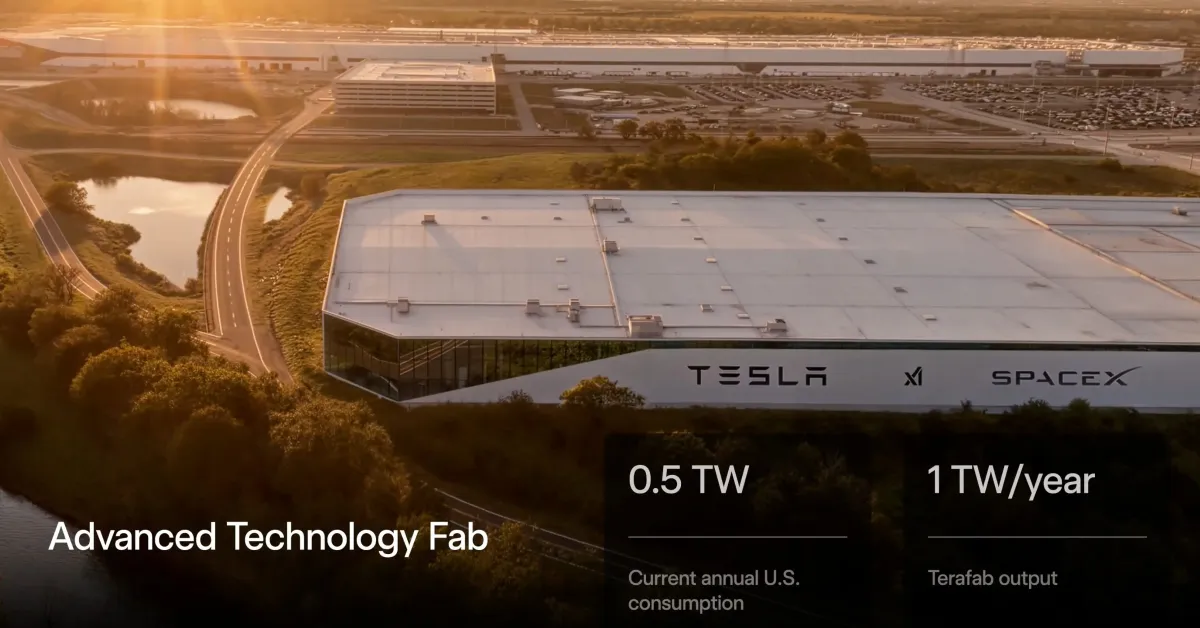 Image: electrek.co
Terafab addresses this by enabling “recursive improvement” – building better chips faster because design, fabrication, memory integration, and testing all happen in one location. This vertical integration mirrors what Tesla did with batteries at its Gigafactories but applied to the silicon that powers modern machine learning and neural networks.
For the AI and machine learning community, this could accelerate progress in large language models, deep learning inference for autonomous systems, and real-time neural network processing in robotics. By reducing dependency on foreign supply chains, Terafab also mitigates geopolitical risks that have plagued the semiconductor industry.
Space Compute and the Galactic Vision
One of the most fascinating elements of the Terafab announcement is its deep integration with SpaceX's ambitions. A significant portion of the compute – potentially up to 80% – may eventually support orbital AI data centers. Space-based computing offers compelling advantages: five times greater solar irradiance than on Earth's surface, efficient radiative cooling in vacuum, and no terrestrial power grid constraints.
Musk outlined concepts like the “AI Sat Mini,” a 100 kW (roughly 1 ton) satellite that could scale to megawatts, deployed via Starship. These orbital facilities could become the world's largest data centers, running AI workloads 24/7 without batteries. The presentation tied this to a broader goal of advancing humanity up the Kardashev Scale toward a multi-planetary and eventually galactic civilization.
Future plans even include lunar mass drivers for low-cost payload launching and petawatt-scale compute, highlighting how Terafab is not just about today's LLMs and neural networks but tomorrow's interstellar infrastructure.
Implications for the AI Industry and Practical Insights
For AI practitioners and machine learning engineers, Terafab signals a new era of hardware abundance. Custom silicon optimized for Tesla's specific workloads (inference-heavy for FSD and Optimus) could lead to more efficient models and faster deployment of advanced neural networks. Developers working on robotics or autonomous systems may eventually see benefits through more accessible high-performance inference hardware.
Practical insights:
- For investors: Watch Tesla's capital expenditure guidance closely. While the full $20-25 billion cost isn't yet fully reflected in 2026 plans, successful execution could significantly boost long-term valuation by securing the AI stack from silicon to software.
- For tech companies: Vertical integration of chip production is becoming a competitive necessity. Other AI leaders should evaluate similar in-house capabilities or deeper partnerships to avoid supply bottlenecks.
- For AI researchers: Expect rapid iteration on hardware. When fabs can test new architectures quickly, advancements in deep learning efficiency and novel neural network designs could accelerate.
- Timeline awareness: Initial small-batch AI5 production is expected later in 2026 via partners, with Terafab volume ramp likely in 2027-2028. Real impact on product availability may take 2-3 years.
The project also reinforces Austin's emergence as a major semiconductor hub, potentially creating thousands of high-tech jobs in chip manufacturing and AI engineering.
Challenges Ahead and Path to Execution
Building a leading-edge fab is enormously complex. Technical challenges include achieving stable 2nm yields, managing enormous energy and water requirements, and recruiting specialized talent in lithography, materials science, and process engineering. Musk acknowledged the difficulty, noting it requires the combined expertise of Tesla's manufacturing prowess, xAI's AI focus, and SpaceX's engineering culture.
Competition remains fierce. TSMC continues to dominate advanced nodes, and other players like Intel and Samsung are expanding. However, Terafab's focus on specific AI workloads rather than general-purpose foundry services gives it a unique niche.
Success will depend on rapid construction (preparations appear underway near Giga Texas) and flawless execution. If achieved, it could position Tesla not just as an EV or robotics company but as a major player in the global semiconductor ecosystem powering the AI revolution.
As Musk concluded, Terafab is a critical step toward “amazing abundance” through sustainable energy, robotics, and space exploration. In the world of artificial intelligence and machine learning, having control over the hardware layer may prove as transformative as breakthroughs in algorithms themselves.
The coming years will reveal whether Terafab lives up to its epic billing, but one thing is clear: the race to dominate AI compute has just reached a new level of intensity.