 Image: nasa.gov
On October 23, 2026, inside a briefing room at Kennedy Space Center, NASA Administrator Jared Isaacman did something the Artemis program has needed for years: he put a realistic calendar on the table and refused to pretend the old one still worked. Artemis III, once billed as the first crewed landing since Apollo 17, is now a summer 2027 low-Earth-orbit docking test. The first American boots back on the Moon are targeted for Artemis IV in 2028. The shift is not a delay dressed up as progress. It is an explicit bet that flying harder, testing earlier, and letting two commercial landers compete on readiness will get astronauts to the lunar surface faster than the previous architecture ever could.
Isaacman, joined by Associate Administrator Amit Kshatriya and Artemis Program Manager Jeremy Parsons, framed the update as an acceleration under President Trump’s national space policy. The goal is an enduring presence, not another flags-and-footprints visit. When the first crew arrives in 2028, NASA expects elements of a Moon base and a rover already waiting near the south pole. China is publicly aiming for a crewed landing around 2029, so the margin is thin and the pressure is real.
Isaacman’s October Briefing Locks in the 2028 Landing
The October 23 session was the most detailed public accounting of the revised plan since Isaacman restructured the program earlier in 2026. Artemis II had already flown in April 2026. Artemis III “must fly” in 2027, Isaacman told reporters, because a low flight rate is itself a safety problem. The agency is still aiming for a year-end tanking test of a short-stack SLS before the end of 2026, with solid rocket boosters already being stacked in the Vehicle Assembly Building.
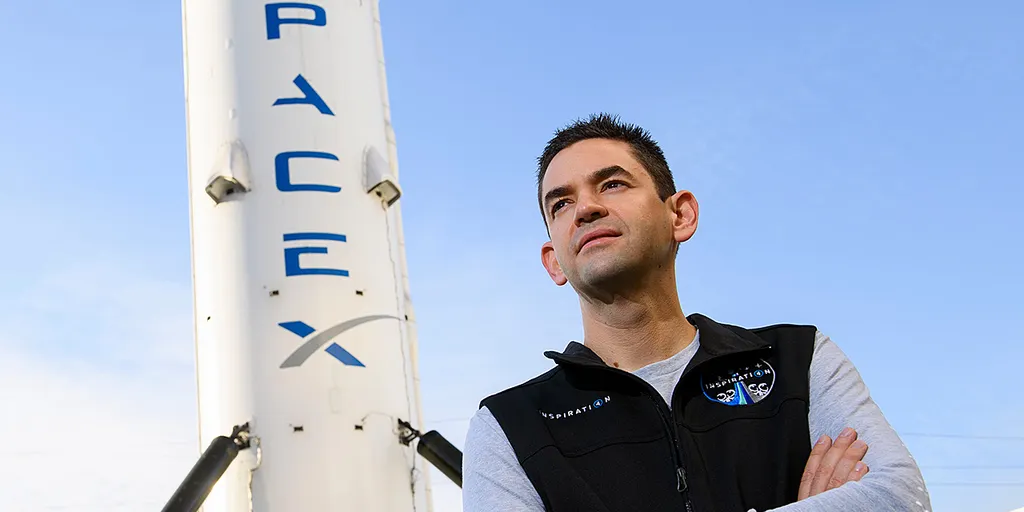 Image: foxnews.com
Neither SpaceX nor Blue Origin has been pre-assigned the first landing. NASA will pick the provider that is demonstrably ready. Both companies are planning lunar landing opportunities in 2028, and a second crewed surface mission remains on the books for later that year. Officials acknowledged supply-chain pressure—particularly avionics—has already pushed Artemis III roughly 90 days, but they insisted the summer 2027 window is still the working target. “This is an achievable path we are on right now,” Isaacman said. “We have the mandate, we have the resources, and the support from our stakeholders.”
Artemis III: A 14-Day LEO Docking Gauntlet
Artemis III will send four astronauts—commander Randy Bresnik, pilot Luca Parmitano of the European Space Agency, and mission specialists Frank Rubio and Andre Douglas—into low Earth orbit for a planned 14-day mission. It is arguably the most complicated launch campaign NASA has ever attempted: three heavy-lift rockets and three spacecraft operating in tight sequence.
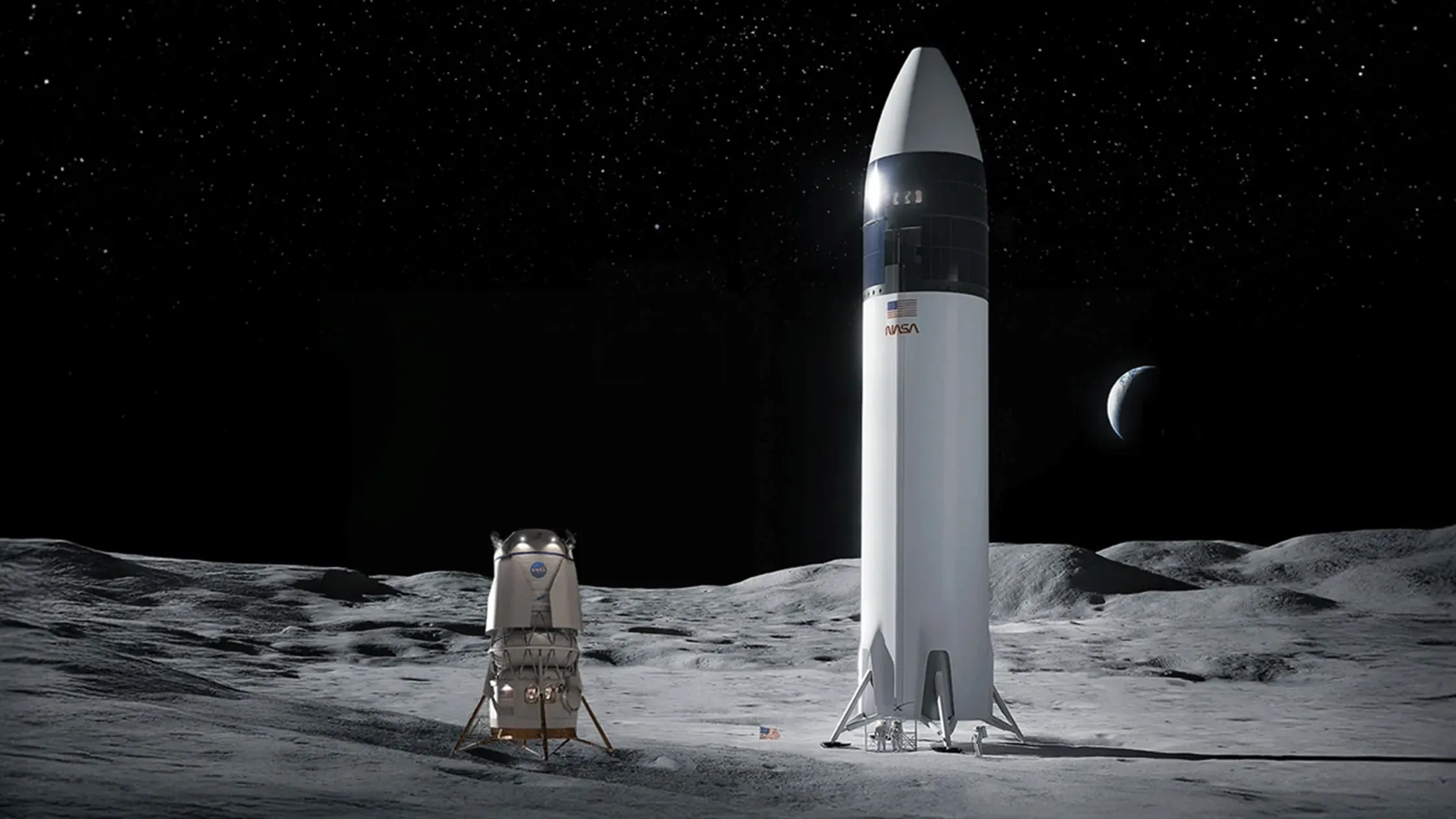 Image: space.com
Blue Origin launches first. A test article of the Blue Moon Mark 2 crew cabin rides New Glenn into a circular orbit about 237 nautical miles up, where it can loiter for up to 30 days. Days later, SLS lifts Orion (using a cylindrical spacer instead of an upper stage) into an initial elliptical orbit. Orion then maneuvers to rendezvous and docks to a side port beside the Blue Moon cabin. Two crew members enter the lander and spend roughly two days evaluating atmosphere, pressure, life support, controls, and emergency procedures. This is the first time astronauts will inhabit a commercial lunar lander in space.
After undocking, SpaceX launches a Starship Version 3 test article from Florida into a lower orbit near 206 nautical miles. Because Starship’s on-orbit lifetime is shorter, its launch is deliberately later in the timeline. Orion docks nose-to-nose with a forward docking system for a test lasting up to two hours. The crew stays inside Orion; the focus is controllability, communications, integrated software, and docking dynamics. Different geometries on the same flight give NASA data it could not get any other way. The remaining days are used for Orion suit evaluations, sensor tests, human-factors work, a cellular biology experiment, plant seeds, and solar observations before a Pacific splashdown.
“Every piece of this mission in Earth orbit is designed to reduce risk before we put astronauts back on the Moon,” Parsons said. “We’re launching three spacecraft on three different rockets and testing how they operate together — something NASA has never attempted.”
Architecture Overhaul: Partner Orbits, Deferred Refueling, and Centaur V
The bigger news is what happens after Artemis III. Landers will no longer meet Orion in a near-rectilinear halo orbit. Each provider now uses an orbit matched to its vehicle.
For SpaceX, Starship HLS will be refueled in low Earth orbit by a depot fed by tanker flights, then climb to meet Orion in a higher Earth orbit. After docking, Starship itself performs the trans-lunar injection burn and delivers the combined stack to low lunar orbit. NASA is modifying Orion so it can be pushed by the lander and still retain enough propellant for the return. The change cuts the amount of propellant Starship must aggregate and shortens the time between surface ascent and rendezvous with Orion. Propellant transfer will be demonstrated on the required uncrewed mission.
Blue Origin is deferring propellant transfer for its accelerated 2028 path. Three transfer stages, derived from existing Mark 1 and Mark 2 hardware and flown like a multistage rocket, assemble with the Blue Moon Mark 2 Alpha lander in low Earth orbit and push it to an elliptical polar lunar orbit. Orion launches separately and docks there. The elliptical orbit offers faster emergency returns, lower lander propellant demand, and better use of SLS performance. NASA is also preserving a low-lunar-orbit option.
That option depends on a new upper stage. After canceling the Exploration Upper Stage over cost and schedule growth, NASA selected United Launch Alliance’s Centaur V as the standardized SLS upper stage. A stretched “180K” variant with roughly 50 percent more propellant is in development specifically to help deliver Orion into lower lunar orbits. Artemis IV could fly either the final Interim Cryogenic Propulsion Stage or the stretched Centaur V; the decision point is next summer, around the Artemis III window. The stretched stage would require Mobile Launcher modifications, but it gives Blue Origin a cleaner path to low lunar orbit if needed.
Suits, Uncrewed Demos, and the Race to the Surface
Spacesuits were on the critical path and have been deliberately simplified. Axiom Space’s full AxEMU exceeded its mass allocation. NASA directed a lighter “Sortie Suit” derivative that cuts weight roughly in half—from more than 500 pounds to about 250 pounds—by reducing complexity and simplifying lander interfaces. It is certified for short surface excursions of at least two hours and is not rated for the coldest permanently shadowed regions. Artemis IV is planned for two moonwalks of a couple of hours each. The full-capability suit continues in parallel for later, longer campaigns. On Artemis III itself, crews will fly and evaluate elements of the Orion survival suits and practice donning and doffing concepts rather than a complete surface-suit certification.
Both companies must fly an uncrewed demonstration of their crewed lander before NASA puts astronauts on it. SpaceX is targeting an uncrewed lunar landing demonstration by the end of 2027. Blue Origin’s uncrewed Mark 2 demonstration is aimed at early 2028, building on earlier robotic Mark 1 flights. NASA will certify systems only after those flights and the Artemis III data are in hand. The agency intends to wait as long as practical before naming which lander flies first in 2028.
What It Means and What to Watch Next
The practical implication is a higher-tempo, competition-driven program that accepts more near-term complexity in exchange for earlier operational data. Three of the world’s most powerful rockets must fly in coordinated windows for Artemis III alone. Any slip in New Glenn’s return to flight, Starship’s cadence, SLS tanking, or lander avionics cascades directly into the 2028 landing window. At the same time, dual paths and deferred decisions reduce the chance that one company’s delay grounds the entire effort.
- Watch the late-2026 SLS tanking test and core-stage stacking progress—these are the clearest near-term signals that Artemis III’s summer 2027 target is holding.
- Track uncrewed lander demonstrations in late 2027 and early 2028. NASA has said these are non-negotiable before crew.
- Follow the Centaur V decision next summer. It will reveal how aggressively NASA is pushing the low-lunar-orbit option for Blue Origin.
- Expect provider selection for Artemis IV to stay open until flight data, not press releases, forces the call.
- For industry watchers, the contract realignment means both companies are now on the critical path for early landings rather than sequenced years apart. Supply-chain interventions from NASA leadership are already happening in real time.
Isaacman’s team is betting that Apollo-style urgency, commercial competition, and a willingness to rewrite orbits and requirements mid-stream can close a gap that had been widening for years. The October 23 briefing did not eliminate risk. It made the risks visible, assigned them to specific flights, and set a public deadline. If Artemis III flies in 2027 and at least one uncrewed lander succeeds shortly afterward, 2028 stops being a slogan and becomes a launch window. If those demos slip, the second space race gets tighter in a hurry. Either way, the architecture that will actually carry the next Moonwalkers is no longer the one drawn up when Gateway and a single NRHO rendezvous were still the plan. The new one is flying, or failing, on a much shorter clock.