 Image: theverge.com
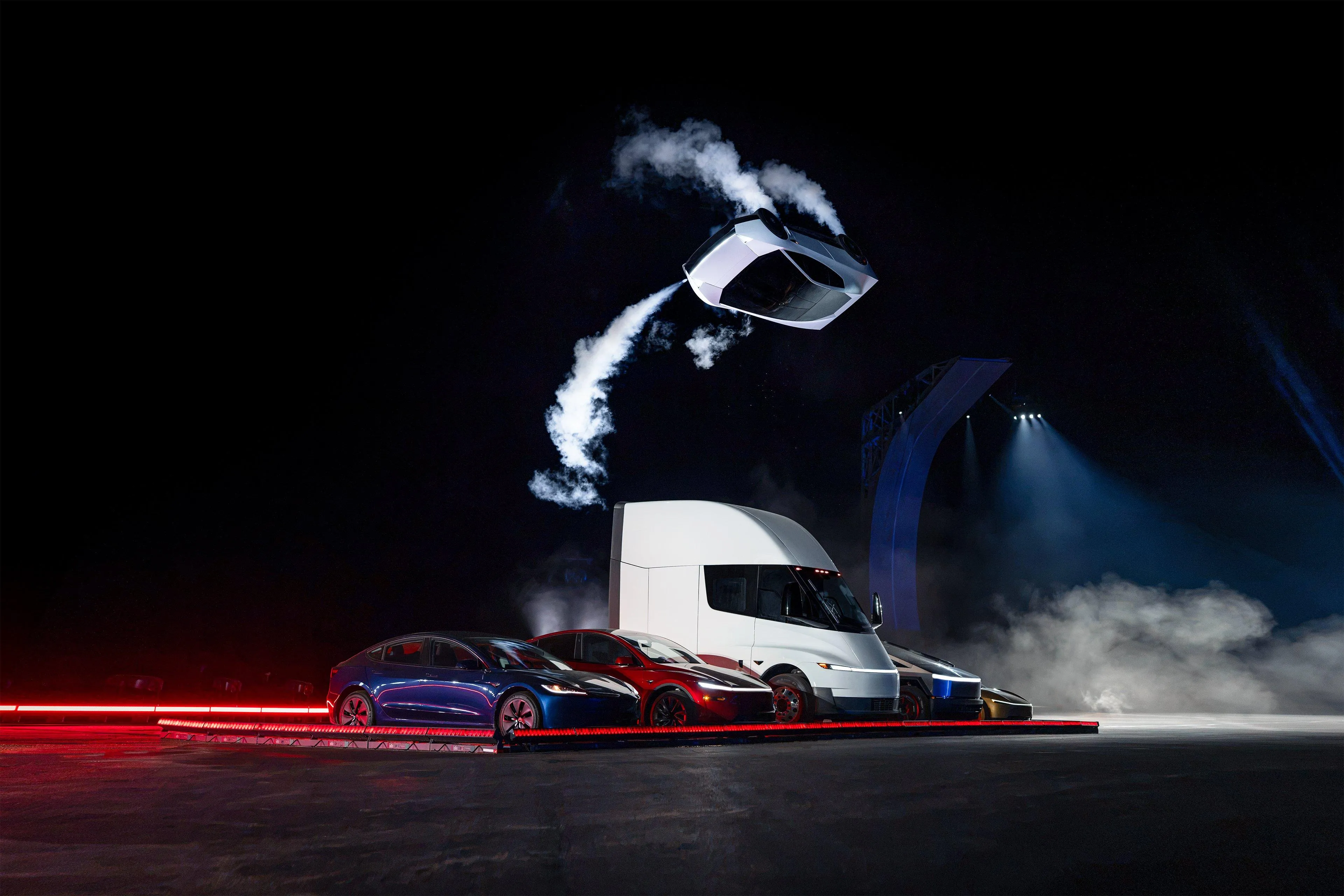
Tesla’s second-generation Roadster finally left the ground on October 15, 2026, and for a few hours the internet treated a short hop like the flying-car future had arrived. At SpaceX’s rocket test site in McGregor, Texas, a remotely controlled prototype drove nearly upside down on a curved ramp, launched off the edge, and used cold-gas thrusters to flip over a lineup of Tesla vehicles before landing on its wheels. CEO Elon Musk told the live crowd the stunts were real, not generated by artificial intelligence. Snopes later found nothing to suggest the livestreamed footage was fake or edited.
The show was spectacular. The product story is narrower. Tesla is taking reservations, targeting production in 2028, and offering three versions. Only the invite-only Rocket trim does the aerial tricks, and the company says that version is not approved for public road use. For everyone else, the flying Roadster is still a promise with a very long runway.
What the McGregor Demo Actually Showed
The event started at 7:55 p.m. Central at SpaceX’s rocket test and development center near Waco, a site hosts described as about 4,000 acres. Tesla had originally aimed for October 1 and moved the date after severe weather forecasts. Musk said the company needed a live audience so viewers would not dismiss the footage as AI. The airborne runs were not driven by a person. Musk said the demo was technically autonomous so nobody would get killed, and a show figure occupied the seat for the cameras.
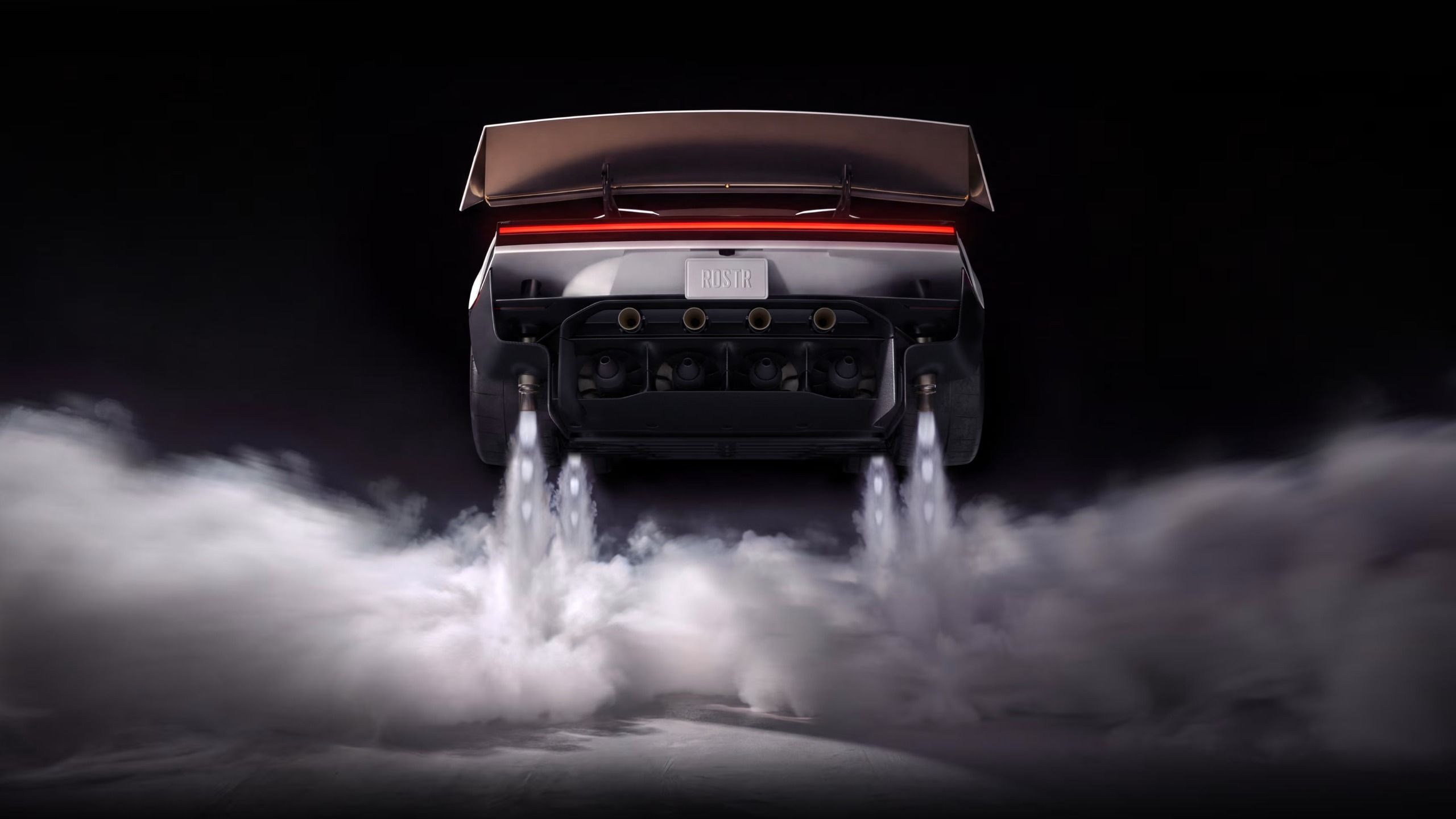 Image: tomsguide.com
The first sequence looked like a full-size Hot Wheels loop. The Roadster climbed a curved ramp until it was nearly inverted, held to the surface by an underbody suction-fan system Tesla says can generate up to 2Gs of pull. Reporting from the event described the car pitched near 170 degrees and roughly 21 meters off the ground, with a downforce readout around 4,700 kilograms. It then let go. Thrusters rotated it and softened the landing in a cloud of vapor.
The second run is the clip that traveled. The Roadster accelerated toward a Cybercab, a Cybertruck, a Tesla Semi, a Model Y, and a Model 3, fired its thrusters, and completed a midair flip Tesla called a kickflip, clearing the row before settling back onto the pavement. Lars Moravy, Tesla’s vice president of vehicle engineering, joked that Tony Hawk would be proud. A separate acceleration run, thrusters engaged, was timed by Tesla at 0.81 seconds from 0 to 60 mph. Musk said production cars should be quicker, limited mainly by what a human body can tolerate, and he cautioned that he was not sure the stunts would be legal in every jurisdiction. He also said the car was not necessarily safety-optimized.
Cold Gas, Not a Rocket Engine
This is not a winged aircraft, and it is not a chemical rocket. The airborne hardware is a cold-gas system developed with SpaceX engineers, the same family of technology used to adjust a spacecraft’s attitude, scaled into a sports car.
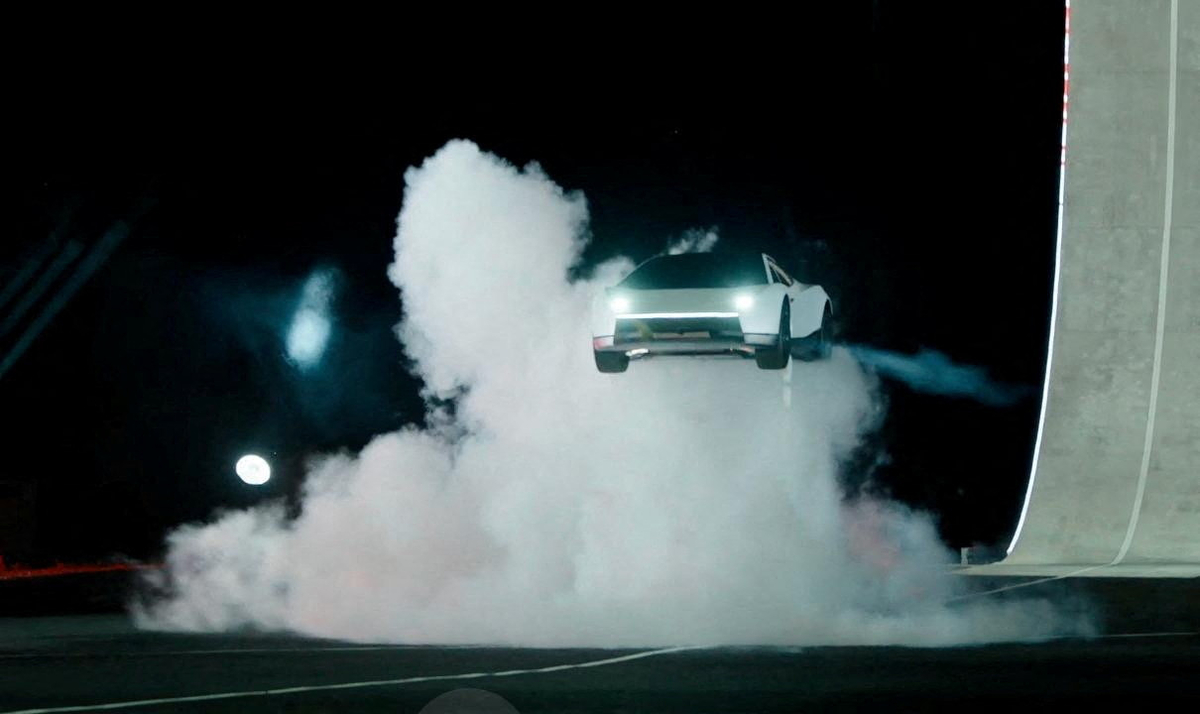 Image: en.sedaily.com
- About 10 directional thruster nozzles, fed by ultra-high-pressure air tanks totaling roughly 600 liters and on the order of 250 kilograms of compressed air.
- Tanks that can be refilled without chemical propellant, which is why the exhaust looks like vapor rather than flame.
- A claimed thrust figure above 80 kilonewtons on the higher configurations.
- An underbody suction system, separate from the thrusters, that pins the car to a surface for the upside-down climb and is meant to add grip on a track.
The bursts are short. Engineers and reporters who watched the livestream have been consistent on the limit: this is a hop, a flip, and a controlled landing, not sustained flight you could use to skip traffic. Musk’s line that the car can “fly like a rocket” and “do rolls” describes the party trick, not a commute. On stage he also recycled an old Peter Thiel quip — that the future promised flying cars and delivered 140 characters — and declared that era over. The hardware on display supports a few seconds of that claim, on a closed test site, with no driver aboard.
Performance, Thrust, and Rocket
Tesla split the car into three configurations, and the labels matter more than the highlight reel. Mixing them up is how a reservation turns into a disappointment.
- Performance is the road-ready car. Two seats, active aerodynamics, and the multi-mode suction system. Tesla claims 0 to 60 mph in under 1.6 seconds. A reservation is $50,000: $5,000 up front and $45,000 within 10 days. That is a reservation, not a purchase price.
- Thrust is the limited, race-oriented version. It keeps two seats and adds rear cold-gas thrusters aimed at acceleration rather than lift. Tesla claims under 0.9 seconds to 60 mph. Reserving one costs $250,000, and availability is capped.
- Rocket is the car from the video. It seats one, because passenger space is given over to the high-pressure tanks, and it carries thrusters around the body for lift and rotation. Tesla claims under 0.59 seconds to 60 mph. It is invitation only, will not be offered in every region, and Tesla marks it as not approved for public road use.
If the kickflip is what you want, you cannot order it the way you order a Model Y. The version most buyers can reserve does not fly. Final pricing for any trim has not been announced, and Musk has said he is not sure the Roadster moves the needle much on revenue next to higher-volume models.
What Changed Since the 2017 Promise
The second-generation Roadster was first shown in November 2017. Customers could put down $50,000, or $250,000 for a Founders Series. Tesla then talked about a 2020 production start, a 1.9-second 0 to 60, more than 250 mph, about 620 miles of range, a 2+2 layout, and a base price around $200,000.
The 2026 car is quicker off the line and far more theatrical. It is also smaller in almost every practical dimension Tesla used to sell. Range is now listed as more than 300 miles. Engineers speaking with outlets including InsideEVs have put real-world range closer to 310 to 320 miles, a cut tied in part to keeping the car light, around 3,700 pounds. The rear seats are gone. Drive is rear-wheel drive with two motors and torque vectoring, not the three-motor all-wheel-drive layout from the 2017 pitch. Peak output figures discussed around the reveal cluster near 1 megawatt, roughly 1,341 horsepower, on the higher versions, with base output reported above 800 kilowatts. Claimed top speed sits above 230 mph, below the old 250-plus figure, though Musk has talked about eventually chasing much higher speeds. Those faster targets are not current specifications.
Charging is one of the more useful updates. Briefings around the reveal described the pack as Tesla’s fastest-charging yet, with talk of a 15-to-85 percent session in about 10 minutes on the newest Superchargers and peak rates discussed from about 500 kilowatts up toward 1 megawatt. Battery capacity has not been officially disclosed. Chief designer Franz von Holzhausen has also pointed to a limited version of Full Self-Driving, but this reveal was framed as the opposite of a robotaxi pitch: a driver’s car, which Musk called both a flying car and the last best driver’s car.
Production is now set for 2028. The stage line was “for real,” eight years after the original target. Tesla has development prototypes and has talked about a larger build before customer production, but there is still no final price and no firm delivery date. The reservation agreement does not guarantee when a car will arrive.
What to Know Before You Reserve
If the demo made you reach for a card, the fine print the livestream skipped is the part that matters.
- Match the deposit to the car. Performance is the open reservation and does not have the flight system. Thrust adds acceleration thrusters and a $250,000 hold. Rocket is not a public-road product and is not openly for sale.
- Treat the money as a long hold. Production is targeted for 2028 after nearly a decade of slips. A reservation is not a locked price. Confirm current refund terms on Tesla’s agreement before you wire the balance. Missing the 10-day window on the second payment can cancel the reservation.
- Do not plan a commute around thrusters. Even on the Rocket, the demonstrated capability is a short burst of compressed air, measured in seconds, on a closed SpaceX site. Regulatory approval for anything like flight on public roads does not exist for this car.
- Wait for independent timing. The 0.81-second run was Tesla’s timer, with thrusters firing. Other specialty EVs have already shown extreme acceleration, inverted running, or short jumps. The combination here is new. The verified numbers are not in yet.
- Ignore the next stunt as a delivery signal. Musk has teased a follow-up in the spirit of Evel Knievel’s Snake River Canyon jump. That would be another show. It would not move the production calendar.
Early deposit holders from 2017 are in a particularly awkward spot. Tesla has not clearly spelled out how those old reservations convert onto Performance, Thrust, or Rocket, or what happens to a $200,000 price that was never a contract. Anyone in that group should read the updated agreement rather than assume the 2017 terms still govern.
The Show Landed. The Car Has Not.
The McGregor night did what Tesla needed it to do. It put a real prototype in the air in front of real people, ended the “is this AI?” argument, and reminded the industry that a company with a rocket division can stage a reveal nobody else can copy. Cold-gas thrusters, a 2G suction floor, and a sub-second sprint are genuine engineering, not a rendering.
They are also not a flying car you can buy this year, or next year, or drive to work. The version that flew is invite-only and off public roads. The version you can reserve is a very fast electric sports car with a suction system, a halved range claim, no published price, and a production date that sits in 2028. For people who have waited since 2017, the demo is proof the project is still alive. It is not proof the keys are close.
Flying cars, in the everyday sense, are still mostly a slogan. For one evening in Texas, Tesla made that slogan literal, for a few seconds, on purpose. The harder part — a price, a factory cadence, and a car that matches the video without requiring an invitation and a closed course — starts now.